CLICK HERE FOR BLOGGER TEMPLATES AND MYSPACE LAYOUTS »

Final Opening Sequence

Final Opening Sequence

Preliminary Task

Preliminary Task

Tuesday, 5 April 2011

Note to Moderator

Dear Moderator,

Here is my finished blog, I very much hope you enjoy reading it and I thank you for taking the time to do so. You will see on the right of my blog I have links to my Group 1 blog, Alexander Thoupos' blog and Matthew Smith's blog which will hopefully allow easy navigation for you. I also have a link to the class blog, labelled BLK Foundation Blog, which itself contains links to all the blogs in my class.

On my blog you will find evidence of Research, Planning, Production and Evaluation, ranging from theory and narrative structure research to final scripts. You will see my preliminary task video at the top of this blog, and all my evidence for that is labelled Preliminary Task.

On my group blog you will see labels for Research, Planning, and Production as well as the labels for the names of each group member. Under the label James, you will see the posts I personally was resposible for.

Thank you again for taking the time to read my blog
Kind regards
James Reader (3650)

THIS BLOG IS NOW CLOSED!

Unfortunately, my time is up
I have enjoyed this media course, as I thought I would and it is a shame that it is over so quickly

THIS BLOG IS NOW CLOSED!

Monday, 4 April 2011

Evaluation Question 1

In what way does your media product use, develop or challenge forms and conventions of real media products?


The chosen genre of our film was Action Horror. We chose this genre for our film as not only did we like it as a group ourselves, but it was also very popular with our primary target audience who were 15-25 year olds males.
I Am Legend (Lawrence, 2007) was an influential film for us as it fit into the genre of Action Horror and also had a similar theme to our own film. The ‘beasts’ in our own film were also based on the antagonists from I Am Legend, as they hide in the shadows and attack humans.
Another film which influenced our costume choice was Green Zone (Greengrass, 2010). In this film they enter a dark area wearing gas masks and suits. These soldier costumes helped us to really visualise how our own soldier would look in our opening sequence.

In our film we followed typical conventions of our Action Horror genre. Our main character in our opening sequence is portrayed as the tough military sergeant who inevitably ends up getting killed by one of the antagonists. We have also followed conventions as our film also has typical events and settings for the Action Horror genre e.g. dead civilians, empty residential streets, unseen ‘beasts’ etc. In post-production, we added an effect to our whole film which gave our whole sequence the typical ‘post-apocalyptic washed out’ look, which I think was very effective.

Continuity is also a big convention of films. In our sequence we tried to stick to continuity techniques such as match-on-action, eyeline matching and the 180 degree rule. However, we found we had one continuity error in our piece. When one of the Forensic officers turns to call the Soldier over, you can see the Soldier through the gate. In the next shot, however, he is a few metres down the street from the gate, and he then walks to the position he was previously standing in a few moments later.


The narrative structure to our film is also quite conventional, as it uses theories from Propp, Levi-Strauss and Todorov. We used Levi-Strauss’ theory of binary opposites to help us plan our film’s plotline. The binary opposites we used were:

·                     Good vs. Evil
·                     Known vs. Unknown
·                     Humans vs. Creatures
·                     Normal vs. Strange
·                     Life vs. Death
·                     Light vs. Dark
·                     Guns vs. Claws/Teeth

(Known vs. Unknown and Normal vs. Strange were used particularly in our opening sequence)

We also used Propp’s 8 character theory, which as you can see in the table below, can be compared to James Bond: Casino Royale which is a popular Action Film for our target audience:


Finally, we used Todorov’s theory of Equilibrium:
IMG[1]


Our film uses screen effects to wash out the colours and this gives the film a ‘post apocalyptic’ feel to it. Our soundtrack also backs this up as it is mysterious and builds tension at the start, but becomes more and more fast paced until the end where it builds up to its maximum before suddenly stopping. In one of our establishing shots we also use a gunshot which helps to establish the action part of our genre early on in our film’s opening sequence.  
Specific narrative techniques we used in our opening sequence include Real Time editing (i.e. our film does not contain montages or dissolves to show time has passed so that it flows as one continuous sequence). We use enigma codes (there is the enigma around the soldier in the gas mask as to who he is before the reveal, also the enigma of what is watching the forensics/who has killed the girl)


We also use action codes (what’s going to happen to the soldier when he goes into the garden, what has happened to the forensics/ why are they screaming)

I believe our opening sequence follows the typical features of an opening sequence of the Action Horror genre. It starts off with an establishing shot of an empty public area (a park) and then dissolves into the action of the soldier wandering down the street. I think our opening sequence sets up the rest of the film and straight away, through the dialogues and costumes, the audience can tell the genre and some of the background information they need to know for the plot of the film.

Our film opening sequence is very similar to that of Night of the Living Dead (Romero, 1968) as both sequences start with an empty shot and then gradually build in the characters and the tension. The Night of the Living Dead opening sequence shows a car driving along an empty road to a graveyard, where two characters are then introduced through dialogue. In a similar way, our sequence opens with a soldier walking down the street where he meets two forensic officers, who are introduced through dialogue.
Chart showing how our film compares to the typical conventions of Costume, Camera,
Setting and Posters for our own film

Evaluation Question 2

How does your media product represent particular social groups?

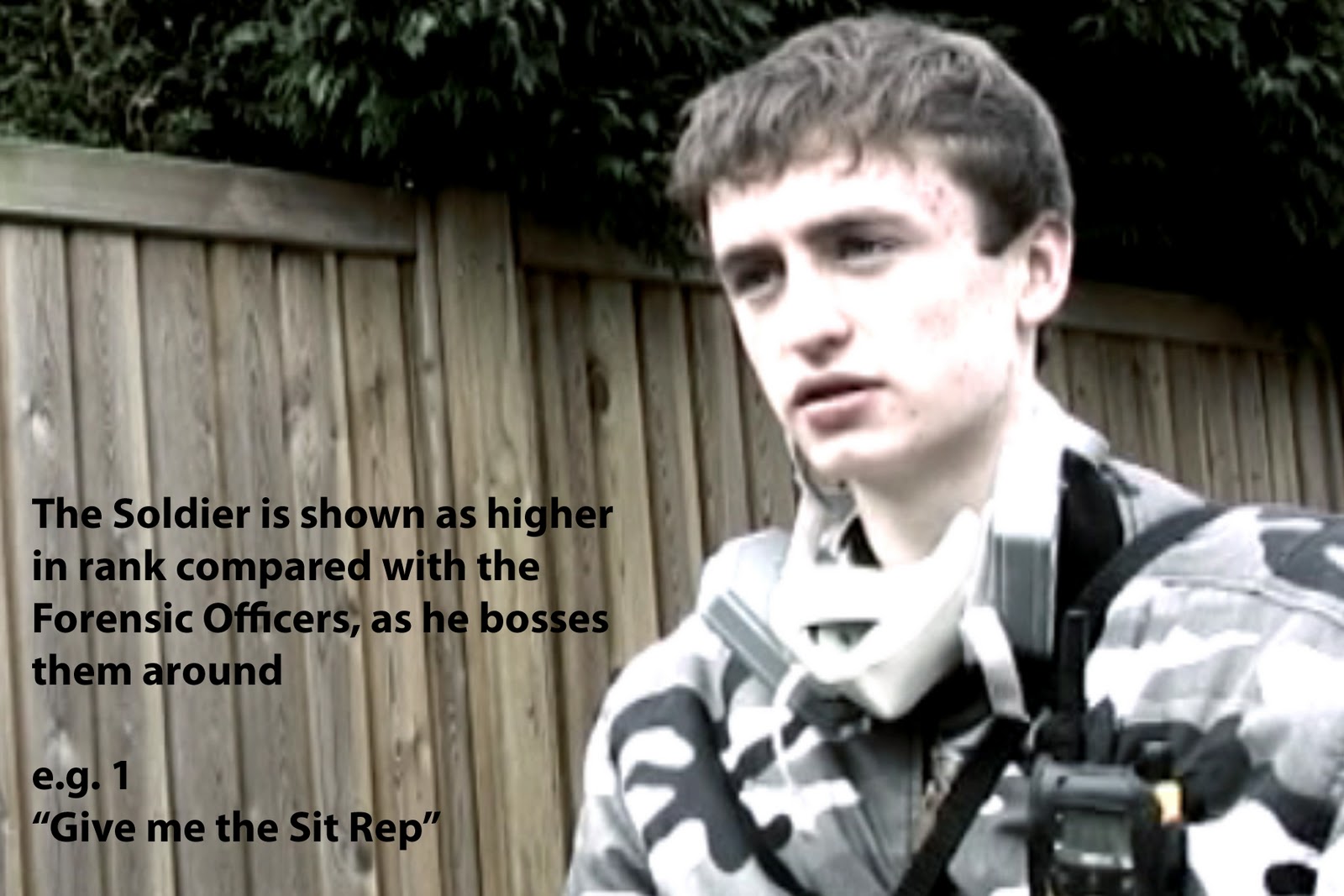
The opening sequence of our film represents the typical strong, British army officer. This is shown with his costume, props and through the way he talks to the forensic officers. His costume and props clearly show he is an army figure as the clothes are camouflaged. The body language and the way he talks towards the forensics also shows he is above them in ranking, as he bosses them around.


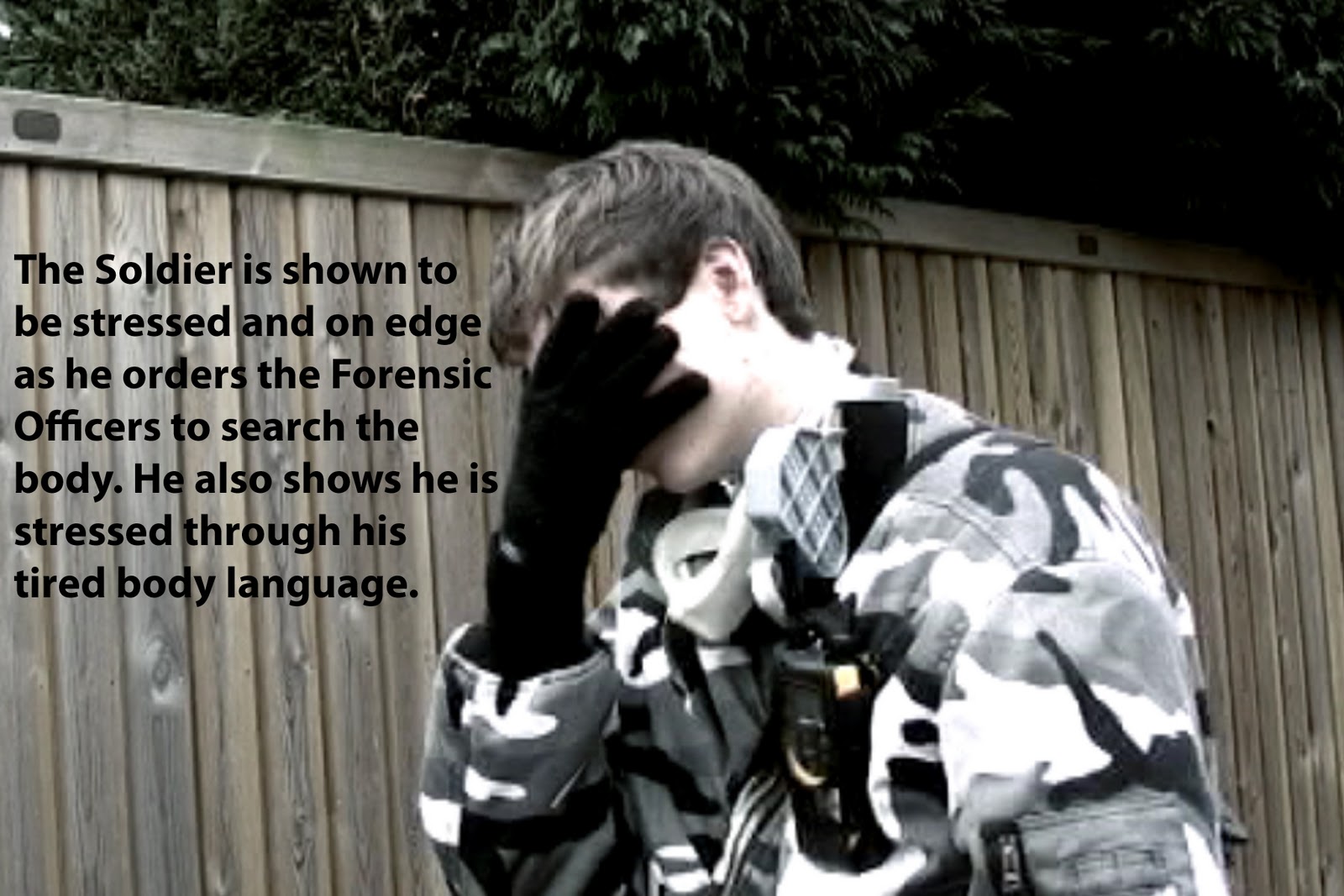
However, throughout the sequence we have shown that he is stressed and on edge as before he starts talking to the forensic officers, he leans against the fence and wipes his brow. He does this again after the conversation, showing that he is strained and under pressure. His authority is also shown over the forensics as he raises his hand to the first forensic when he calls for him to tell him to be silent.


We also represented the beast as being the unknown danger, preying on the vulnerable humans. We planned the sequence so that you never see the beast, adding to the tension and enigma. We also learn that the beast’s first victim was a young teenage female, also portraying the fact that it possibly preys on the weaker humans.

Evaluation Question 3

What kind of media institution might distribute your media product and why?

Our production company is Mangleweb Pictures.


We specialise in Action Horror movies which appeal to the vast British audience. Cataclysm is our first of (hopefully) many productions we will produce. The target audience of our films are generally British young people, who are most interested in the genre of Action Horror. We are similar to DNA films, who produced 28 Days Later (Boyle, 2002) for a worldwide audience which was based in London. However, their film was distributed by 20th Century Fox Film Corporation who are a worldwide company and our film is more indie.


Our film Cataclysm (above) and 28 Days Later (Boyle, 2002)

As we are an indie company who produce films for specifically a British audience, we would most probably use our own distribution company, Bullseye Distributors, to distribute and promote our film.
A possible logo for our indie distribution company, Bullseye Distributors
Ideally, we would like to use a distributor who has global reputation and links, but unfortunately our films do not appeal to a wide enough global audience for that method to be worthwhile. This is why we would use our own individual distributors. Using our own distributor would also give us more input into the promotion campaign and theoretically get more profit from sales, as we wouldn’t have to pay the distributors.
To exhibit our film, we would probably use a film festival rather than a large London premiere. This is due to the fact that our film is aimed at a British audience, rather than a global audience.

Evaluation Question 4

Who would be the audience for your media product?

Here is an audience profile of a typical member of our primary target audience:


Age: 15-25 years old
Gender:  Male
Nationality: British
Lifestyle/attitude to life: Laid back, typical film goer
Tastes in media: Interested in watching films, particularly enjoys horror movies
Film consumption habits: Goes to the cinema with friends on weekends / Friday evenings. Sometimes downloads movies at home from internet when watching alone.
Fandom/ expertise: Possibly knows a lot about horror films, enjoys watching them more than learning about the behind-the-scenes of media companies.


Alternatively, here is a profile of our secondary audience:


Age: 15-25 years old
Gender: Female
Nationality: British
Lifestyle/attitude to life: Likes films, doesn’t always have time to go to the cinema to watch them
Tastes in media: Enjoys horror movies, interested in films
Film consumption habits: Goes to the cinema with friends on weekends / Friday evenings. Sometimes downloads movies at home from internet when watching alone.
Fandom/ expertise: Possibly knows a lot about horror films, enjoys watching them more than learning about the behind-the-scenes of media companies.


As you can see from the profiles above, our primary audience is a national niche group of mainly British young males. However, our secondary audience is young British females who are particularly interested in the genre of Action Horror.
We chose these audiences as they are generally most interested in the Horror genre, which our film could be categorised as

Evaluation Question 5

How did you attract/address your audience?

Our core target audience for this film was 15-25 year old British males. To attract them in our film, we drew on film plots and aspects that they enjoy. Our audience enjoy horror films largely, and to appeal to the horror aspect we used ripped open dead bodies and beasts. We appealed to the visceral pleasures and the ‘unknown danger’ idea behind horror films to appeal to our niche primary target audience. Our audience also like the Action aspect of our film, so we have put gunshots and action sequences in our film, to build suspense and appeal to our audience.

We used blood to appeal to the visceral pleasures of the audience


We used the unknown idea for the beast through
POV shots of the forensics and soldier.


We added in a gunshot which showed the action genre in our film,
appealing to our primary audience 

When we premiered our film to our audience, we got this reaction:
We also got them to fill out questionnaires based on our film when we screened it to them. Generally our film was received well from our audience, and the feedback we got was very useful. The majority of our audience thought it would be a National film, with a few people saying it could be Global. However the majority of the audience said they would see it playing in a large cinema chain such as Cineworld rather than a small indie cinema.
When we asked our audience what they thought needed improvement, the general feedback was that the acting and lighting could be improved, as it either wasn't very believable or didn't give the desired effect on screen.
Overall our film received good ratings from our audience, with most people giving it 7/10 or above.


Evaluation Question 6


What have you learnt about technologies from the process of constructing this product?


When making our film, I learnt a lot about how to use Adobe After Effects to create gunshots and blood splatters effectively. I also learnt how to colour grade our shots to tint the colour, change certain colours, and give it an overall ‘washed out’ effect in Adobe Premiere Pro.

I learnt how to create the gunshots in Adobe After Effects from a YouTube tutorial. Originally the muzzle flash did not seem to be the correct colour but we as a group managed to work out how to change it so it fitted into the surroundings. We also adding in atmospheric effects to make the gunshot more real such as glow and smoke. Below is the YouTube tutorial I used to help create the gunshot effect.

In hindsight, I probably would have liked to have used a track for the camera so that the tracks could be smooth, as a couple of the tracks we used in our opening sequence weren’t smooth enough. However, I learnt how to use the manual focus on the Canon HDV 30 camera which helped me to shoot some of the shots where the focus shifts during the shot.


Using the Camera on shoot


The different technology had different advantages and disadvantages. The camera’s auto-focus was very useful for focus shifts, but wasn’t very easy to get right so some of our shots are slightly more out of focus than they should be.
If we’d had enough time and enough knowledge, we could have created a beast in Adobe After Effects so that the audience could see what it looked like. However, we kept the beast unseen in our opening sequence which helped to add to the tension that was built with the actions and music.

Using Adobe Premiere Pro to edit our sequence in the Edit Suite

We used Adobe Premiere Pro and Adobe After Effects
to edit our sequence


Evaluation Question 7

Looking back at your preliminary task, what do you feel you have learnt in the progression from it to the full product?


For our prelim task, our brief was to produce a short sequence where a character walks into a room, sits down by another character where they then talk. For our opening sequence, however, we had to create the first two minutes of a film for our choice of genre.
There were differences in all aspects of both tasks, and I feel I have learnt a lot between the prelim and this finished task.

Photobucket

Firstly, planning our prelim was much easier as it wasn’t too complicated and the brief was very clear on what we had to do for our shoot. We could easily storyboard a short sequence and choose a location for our shoot. However, the storyboarding for our main shoot was longer and needed to be altered, even though we had a clear idea before starting.
In our prelim task, we used actors from our own group. However in our final piece we originally were going to use actors from outside of our group. I have learnt from this that you always need a back-up plan if things go wrong and fortunately we did have a back-up plan so we had replacement actors ready if problems arose which we couldn’t avoid.
Photobucket


Finally, editing and working as a team for the prelim was much easier, as there were fewer shots to capture and the film was shorter. Our final piece had a lot more editing to be done which took up more of our time. Due to the increased length of our final piece compared to our prelim, there was more feedback for us to change. However, we altered our sequence as necessary and finished our piece on time.

Monday, 24 January 2011

Individual Idea for Opening Sequence

Working Title:
Shadowhunter

Genre:
Sci-Fi / Action Adventure (with elements of Romance and Thriller also included)

Primary Audience:
Males aged 15-25

Secondary Audiences:
Males aged 25-40 (who are interested in the genre)
Females aged 15-25

Synopsis:
Earth, 2015. After a global outbreak of Necros Disease, a gene deforming disease caused by artificial food produce, the world is in crisis. The majority of the Earth's population are dead or have been "mutated" by the disease, leaving very few "True Breeds". The world needs a solution, the world needs a hero. Nowhere is safe.
But one man has the power to save the Earth. He knows what must be done. He is Shadowhunter.

Tuesday, 19 October 2010

Media Prelim: Final Sequence


Group 1E Final Prelim Sequence - "I've Been Expecting You"

Media Prelim: Question 1

Who did you work with and how did you manage the task between you?

Photobucket
I was in group 1E (pictured above). In my group there were 4 people; Olivia, Narishma, Frank and myself. We each had at least one role in each of the three stages (Planning, Production and Editing)

During the planning, we all helped suggest ideas and storyboarded (Frank did the drawing). We worked well together to plan a final idea and to create a shot plan in chronological order of when we would shoot them.

During the production we each had our own roles:
Narishma - Director and Clapperboard Holder
Olivia - Camerawoman and Sound Director
Frank - Actor
Me - Actor

During the editing stage, we all took it in turns to edit the sequence (doing about a quarter each). However, we all helped each other with ideas about how we could order the sequence and improve the editing on the individual shots.

Media Prelim: Question 2

How did you plan your sequence? What processes did you use? What theories did you try to take into account?

When planning our sequence, we first wrote out a script on file paper, detailing our different shots, mise-en-scene and our dialogue. Using our script, we could then draw out a storyboard.
Originally, we drew our individual shots onto post-it notes so that we could move around the order of shots easily to achieve our final storyboard. Once that was achieved, we drew out our final storyboard onto the template to use during the shoot.
Finally, we planned our shot order based on the difficulty of our shots and the chronology of the individual shots. Doing this as a group made it easier and quicker, and once we had completed the shot order we were ready to shoot our sequence.
When planning our shots on the storyboard we took into account match-on-action (opening the doors), shot-reverse-shot (the conversation) and the 180 degree rule (throughout the sequence). When shooting and editing, we kept to these theories so our sequence made sense and didn't confuse the audience.

Our Draft Storyboard:
Our Final Storyboard (Extract):


Our Shot List:


Our Shooting Schedule:
 

Our Script:

Media Prelim: Question 3

What technology did you use to complete the task, and how did you use it?

PhotobucketTo complete this task we used a range of technology.

When shooting the sequence, we used a Canon HD Video Recorder with a Shotgun Microphone attached to the top of it. We used headphones to hear the sound from the microphone whilst recording, so we could easily hear any background noise. We didn't use artificial lighting in our sequence, as
it wasn't necessary for the narrative of our sequence.

Photobucket
When editing the sequence, we used Adobe Premiere Pro to cut and order our sequences so that they flowed continuously without confusing our audience.

Media Prelim: Question 4

What factors did you have to take into account when planning, shooting and editing?

When planning, the main factor we had to take into account was the location of our sequence, as we had to choose a setting where we could fit the camera, tripod and both actors so that it didnt look cramped and so that we could fit everything into the shot. We eventually chose one of the edit suites in the Media Block, as it was long enough for the character entrance and we could fit all our equipment into the room easily. We also had to take into account the other groups, as they would be shooting in the same area and we had to make sure they weren't in the background of any of our shots.
When shooting and editing, we had to take into account background noise. We had to make sure that if there was any background noise in our shots that it wasn't too distracting and that it didn't suddenly cut our midway through an edited shot in our final sequence.

Media Prelim: Question 5

How successful was your sequence? Please identify what worked well, and with hindsight what you would improve, do differently?

Overall, I think our sequence was good. I think our editing was to a high standard and this worked well, as there was the match on action made the sequence flow and we kept to the 180 degree rule throughout the sequence. We also used shot distances in a logical order, so that the audience is taken over the physical space smoothly, rather than jumping about.
In hindsight, however, I would improve the scene where Frank spins around on the chair (pictured above) as the spin is only shown in one long shot. Originally, we had a close up of him spinning and then we cut back to the longer shot, but this didn't work with the match on action and it didn't appear to be very smooth. I would improve this scene by shooting with easier shots or by spending more time on the editing, which I couldn't do for this task. I would also take more shots for the establishing shot at the start, as the hand isn't at the same height when I open the door as in the next shot, so the continuity is wrong. By taking more shots, we could edit it better and find the correct shot to make it flow. 

Media Prelim: Question 6

What have you learnt from completing this task? Looking ahead, how will this learning be significant when completing the rest of your foundation coursework, do you think?

From this prelim task I have learnt a few things. Firstly, I have learnt about how effective match on action is when it comes to making the sequence flow continually. I have also learnt about the 180 degree rule, and how that is used so the audience isn't confused. Finally, I have learnt that to make it easier at the editing stage, you need to do lots of takes for each shot, so that match on action is easier to edit in. When editing our prelim task, we found it hard to match up all of the shots, as we didn't have enough takes for some shots. For the rest of my foundation coursework, I will try to get lots of takes for each shot, so that when it comes to editing, it will be easier to get match on action and for the sequence to flow continuously.

Monday, 11 October 2010

DYM HW feedback

Very good work, James.  Well done.  May be, you made things a bit more complicated re. Todorov by starting with a dream sequence, but your points were generally sound.

Saturday, 9 October 2010

Media Homework Barthes Five Codes


Forrest Gump Opening Sequence (Robert Zemeckis, 1994)

Enigma Codes: Who is the main character? Where are we as the audience focussing? Why are the man's shoes so muddy? Is he the protagonist or antagonist? What / Who is he waiting for? Why is yhe keeping the feather? Why does he have a suitcase and a box of chocolates with him? Where is he going?

Action Codes: The slight suspense in the opening of this sequence is caused by the flight of the feather, as you never know where it is going to end up until the end of the titles. It lands at the feet of a man on a bench. He picks it up and the audience doesn't know whether he is going to keep it or throw it away. He puts it in his suitcase, which then creates the suspense of what he's going to do with it later. Finally, at the end of the sequence, a bus draws up, and there is suspense as we wait and see if he gets on the bus or if someone he is waiting for gets off.

Semiotic Codes: There are a few semiotic codes in this sequence. Firstly, the skyline of the town which we see above the trees as the feather is flying suggests that the film is set in a rural town, rather than a large urban city. The man's shoes are also dirty and worn, which connotes that he is either poor or has a labour job. His white suit is an opposite however, as it is expensive and smart and is clean. The feather blowing in the wind also connotes the idea that the film may be about the story of a man who gets "blown" in different directions by events in his life.

Cultural Codes: There aren't many cultural codes in this sequence, but towards the end of the sequence the bus stop bench shows the audience that the man is waiting for a bus.

Symbolic Codes: Similar to the semiotic codes, the symbolic codes revolve around the mans clothes and the scrambled flight of the feather, implying that the man could be good or evil and that the film may be about his journey through life as his direction is changed by different events.

Tuesday, 5 October 2010

Media Homework Film Sequence (Continuity)


Casino Royale Construction Site Sequence (Extract) (Martin Campbell, 2006)

This short extract from the parkour sequence of Casino Royale has lots of different examples of continuity editing.
At the start of the clip we see a middle aged black male jump from a crane onto a roof before rolling onto the ground. There is instantly an example of continuity editing as there is a cross cut to a middle aged white male on the next crane. However, we cut straight to a MCU of the white male from an Establishing LS, which means the audience isn't taken across the space steadily.
It then cuts back to the black male jumping off the rooftop, hitting the ground and rolling. This sequence of actions takes place over 3 different shots. There is good use matched cuts and match on action between these shots as the action flows smoothly, as it would in real life.
It then cuts back up to the white male, who looks at the rooftop again before jumping off of the crane. The action here also takes place over numerous shots, but because of good continuity editing the action flows smoothly. Also, when the white male jumps it cuts back to the Establishing LS. This shows the audience how far the gap between the cranes is and gives them a sense of position.
As the white male lands, it cuts to a MS of him clinging to the edge of the crane . It then cuts to a CU of him clambering back up to jump from the second crane onto the roof. This use of shot order steadily takes the audience across the space with the character and gets them involved in the action more. This is also helped by the match on action between shots.
We then get a seqeunce of cross cut shots, which imply that the action we can see from the separate characters is happening simultaneously, as it is a chase scene. These shots have been edited in parallel with one another, and eventually the two characters meet up again, as implied by the cross cutting.
The sequence then cuts to a quick cutaway shot of the lift shaft, where the black male jumps across and then back again to the next floor. It then cross cuts back to the white male sliding down a hole in the floor onto the lower level, and the sequence flows smoothly with the right use of matched cuts and match on action.
After more cross cutting between characters, to show the audience that it is a chase scene and the action is taking place simultaneously, we get another Establishing LS of the exterior of the site, showing that the characters have now moved to another location. The balck male jumps from the building onto a blue lift and down. This is shot in 3 shots once again, which gradually take the audience closer to the character. It cuts back up to a MS of the white male in the building, before cutting to a POV shot of the balck male jumping down. The POV then pans over to the lift controls, which implies to the audience that the white male will use the lift.
There is then a LA shot featuring both men jumping, and this is a good continuity shot as it is a matched cut. This is the final shot in this sequence, and the match on action shows that the black male has got down the builiding in a realistic time, compared with how fast the white male went across the space.

This sequence uses a wide range of continuity editing techniques to a good standard, to realistically show the audience the action as it is happening and the cross cutting also shows the two characters are running simultaneously to one another.